


In the modern business landscape, directors face an array of risks while operating their companies: personal liability for company debts, breaches of directors’ duties, tax liability, and reputational damage, to name a few. But despite the record number of company failures, it seems that for many creditors of failed businesses, the majority of directors of failed companies seem to escape any real punishment or corrective enforcement by the relevant authorities.
One of these enforcement measures lies with the Registrar of Companies and the FMA, under Section 385 of the Companies Act 1993: The prohibition of persons from managing companies. The section applies to companies which have ceased trading or have entered into or completed an insolvency procedure (Liquidation, administration, receivership, compromise).
If the Registrar or FMA is satisfied that the way a person managed the company’s affairs was wholly or partly responsible for the company falling within the section, they may issue a prohibition notice:
“The Registrar or the FMA may, by notice in writing given to a person, prohibit that person from being a director or promoter of a company, or being concerned in, or taking part, whether directly or indirectly, in the management of, a company during such period not exceeding 10 years after the date of the notice “
If the person contravenes the notice, section 386 comes into play:
“A person who acts in contravention of a notice under section 385 or 385AA is personally liable to—
(a) a liquidator of the company for every unpaid debt incurred by the company; and
(b) a creditor of the company for a debt to that creditor incurred by the company—”
A creditor reading these sections may well wonder why they weren’t applied to the directors of the company that left them out of pocket. So how often do the Registrar and FMA actually use this power? Gazette notices allow us to reconstruct the numbers for the past few years.
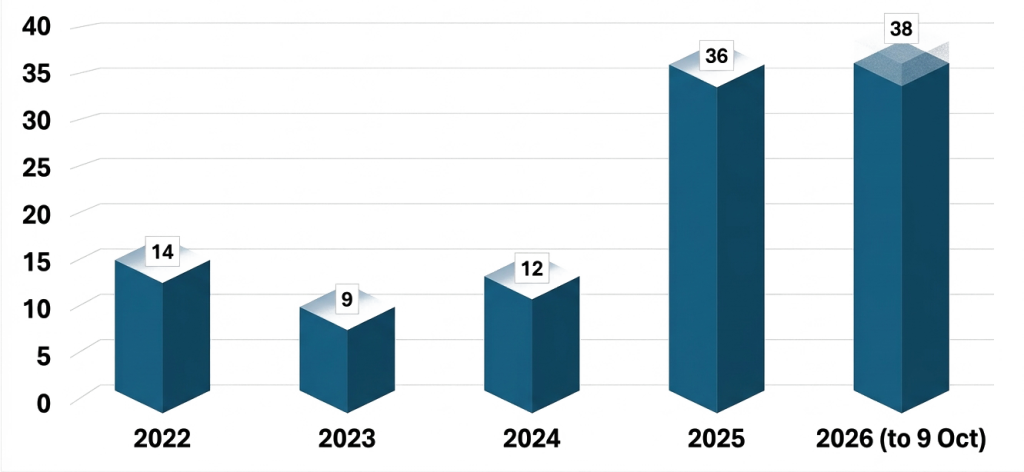
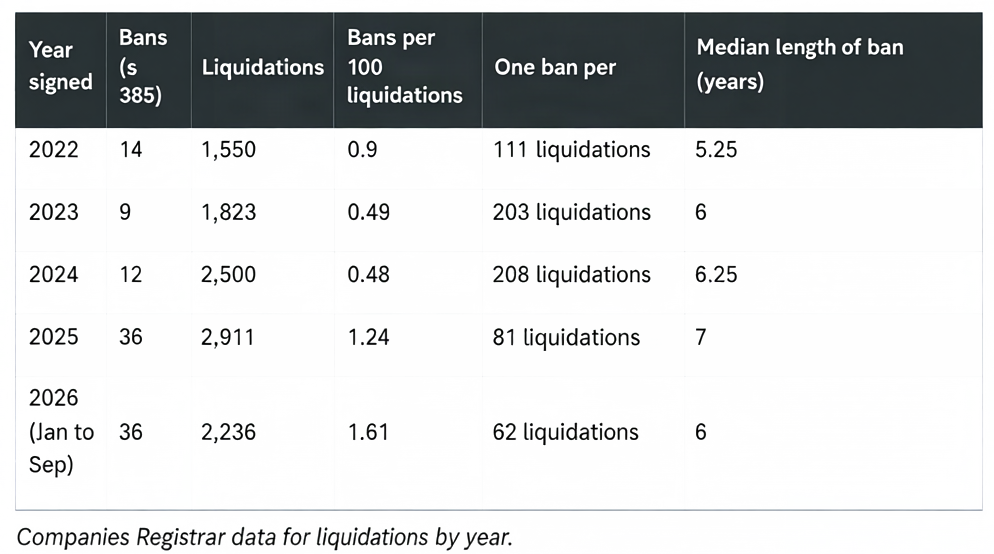
Over this period, use of the section has clearly risen, both in absolute terms and relative to the number of liquidations, as has the severity of the bans imposed, measured by their median length. But even at 1.61% (one ban per 62 liquidations), the Registrar and the FMA still seldom invoke this power.
This raises the question: is the bar for prohibition high, or is enforcement simply low? No data answers this directly, but key points indicate the latter.
Historic underreporting
With thousands of Company failures per year, it is impractical for the Registrar or FMA to individually review the conduct of all the directors or managers of these Companies. Instead, they rely upon notification by creditors, stakeholders, and principally, insolvency practitioners. Historically, the guidelines for what conduct would be notification-worthy were unclear or not commonly known; in almost every case, managers’ actions played at least some contribution towards the Company’s failure.
Reports to authorities of this type of behaviour were likely reserved for the most egregious of cases. In recent years, however, the MBIE has encouraged practitioners to report more frequently on suspected behaviours that would qualify for section 385 and has also pointed to more objective measures for reporting. We suspect this is one of the largest drivers behind the increase in frequency seen, although there is likely a large amount of under-reporting due to the remaining uncertainty held by practitioners when assessing what constitutes the threshold to justify a report.
Partial responsibility satisfies the Act, and Appeals are rare and mostly fail.
In the Act’s own words, conduct can be partially related to the failure of the Company for Section 385 to be triggered. This casts a very wide net for what conduct or decisions a manager can be caught under the Act.
Although the information is sparse on appeals, the cases recorded show that most appeals fail and highlight that, If partial responsibility is enough, an appellant has to show their management played no part in the failure, so the realistic argument is over the length of the ban.
Shifting attitudes towards directors’ accountability
Closely correlated to director bans are the frequency and result of director breach proceedings brought to Court; although there is sparse data on this area, Waterstone has seen more of a willingness by the courts to hold directors personally liable for Company debts. This is to be verified in the years to come.
