


In Reynolds v You & Me Limited [2024] NZHC 3704, the liquidator of Love of Learning Limited (in liquidation) (LOL) challenged a journal entry by which LOL’s debt to You & Me Limited (YML) was partially reduced. The three companies involved—LOL, YML, and Children Teachers Limited (CTU)—were under common control. Mr Collin and Ms Chan were directors of all three companies and, either directly or through entities they owned, were shareholders in all three companies.
At the relevant time, LOL owed YML $141,950, while CTU owed LOL $124,146. The arrangement can be illustrated as follows:
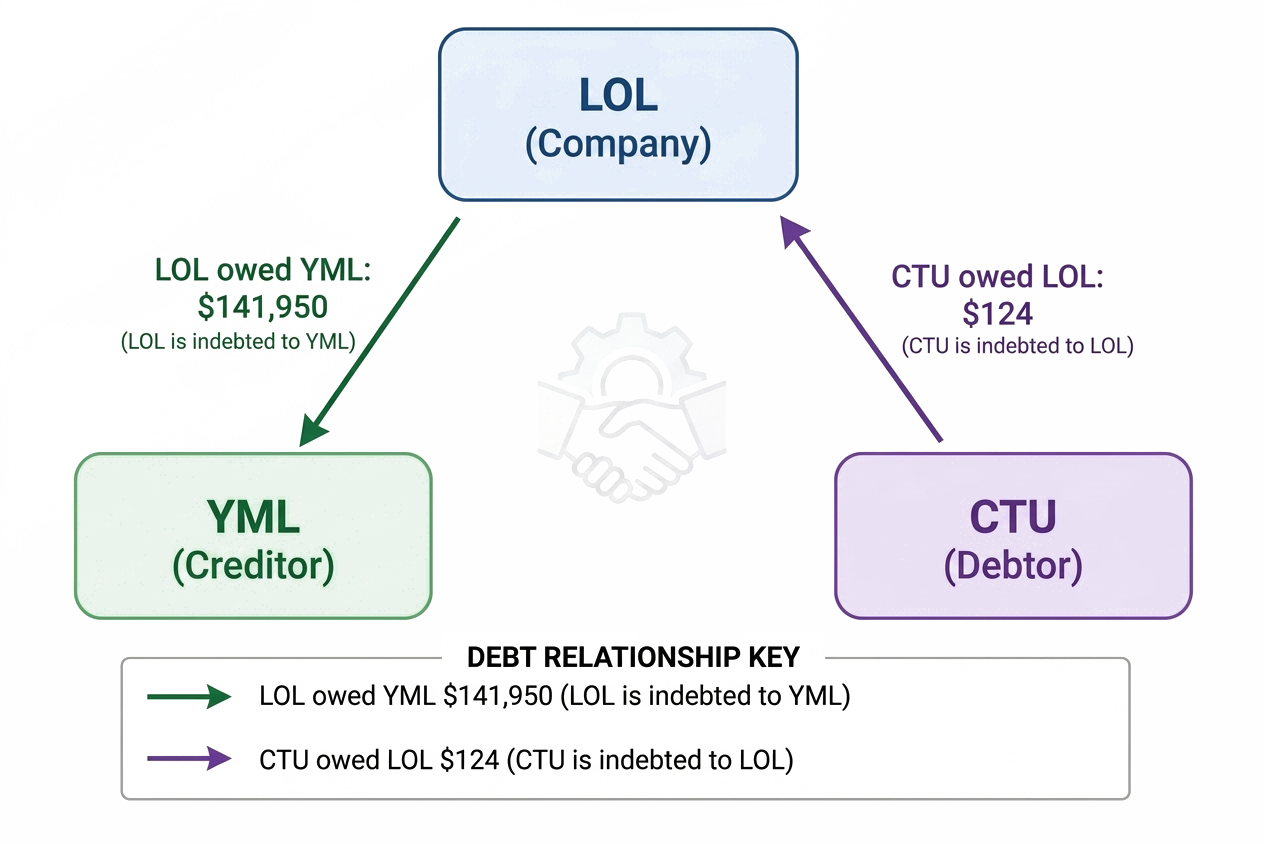
Rather than any cash changing hands, a manual journal entry was made in LOL’s accounts on 16 August 2022. The journal entry recorded an agreement to offset the amount owed by CTU to LOL against amounts owed by LOL to YML and Xinghua Investment Company Ltd (XICL). The amount allocated to YML was $86,902.33, while $37,243.85 was allocated to XICL. I set out the journal entry below, extracted from the judgment:
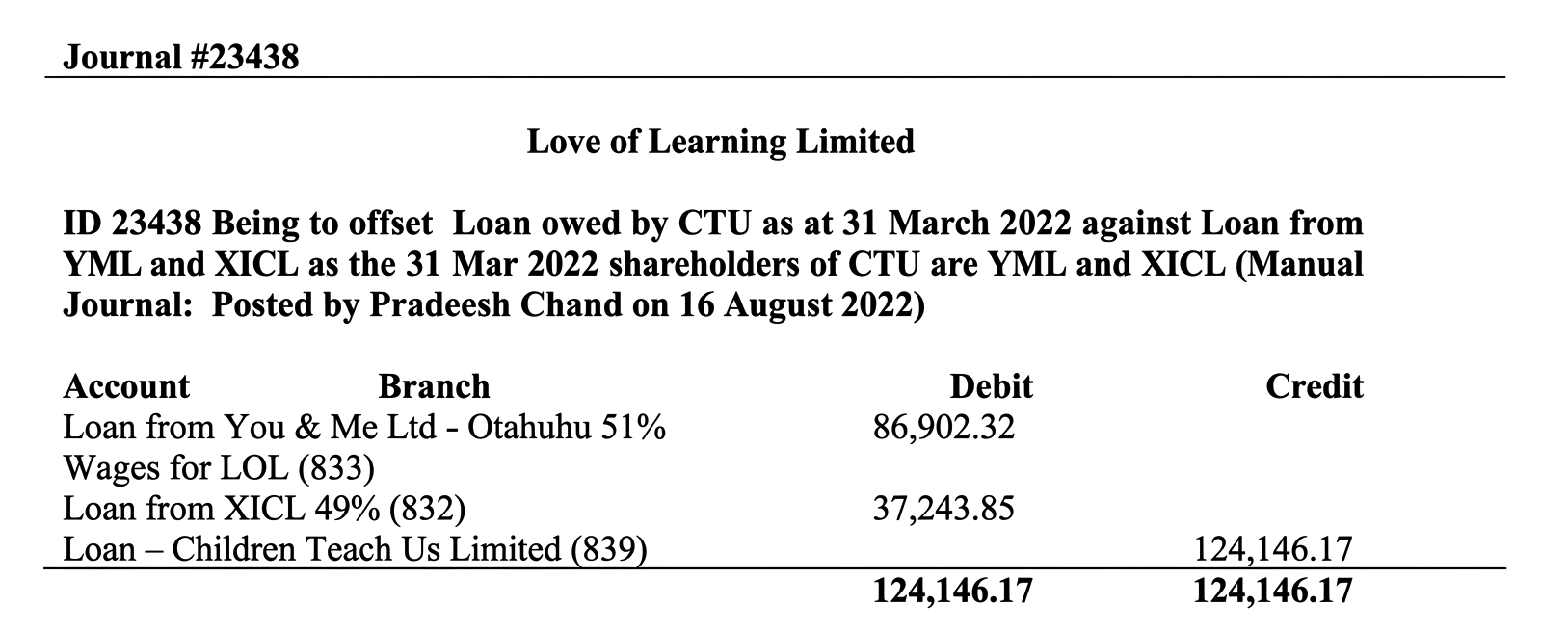
The key issue was whether the set-off effected through the journal entry constituted a “payment” or “transaction” for the purposes of s 292 of the Companies Act 1993, and, if so, what relief should be granted under s 295.
YML argued that the journal entry was merely a bookkeeping entry and did not amount to a payment because no money changed hands. Mr Chan gave evidence that no money was paid by LOL to YML and no money was received by YML as a result of the journal entry. YML therefore submitted that it should not be required to repay $86,902.33 to the liquidator when it had never received that amount in cash.
The Court rejected YML’s submission that it had received no benefit merely because it had not received cash.
The Court held that it was established that a set-off can amount to a payment for the purposes of s 292. The Court relied on authorities including Trans Otway Ltd v Shephard and Rea v Russell, which establish that a debt discharged by way of set-off can constitute a payment and can therefore amount to a preference.
Importantly, the Court adopted a substance-focused approach. The fact that the transaction was implemented by an accounting entry, rather than by a transfer of cash, did not determine whether a payment had occurred. The Court considered the substance of what the parties had agreed and what the transaction actually achieved.
Here, the evidence demonstrated that the set-off was a deliberate and considered transaction, rather than a journal entry created after the event merely to record or re-categorise earlier transactions. The journal entry reduced the amount YML was owed by LOL from $141,950 to $55,047.68. Accordingly, YML’s exposure in LOL’s liquidation was reduced by $86,902.33. At the same time, CTU was relieved of its obligation to pay $124,146 to LOL.
The Court ordered that the journal entry be set aside as an insolvent transaction and that YML pay the liquidator $86,902.33. The fact that the transaction was implemented without a cash transfer did not prevent it from conferring a preferential benefit on YML.
Key takeaway
Reynolds v You & Me Limited demonstrates that a manual journal entry can constitute a payment or transaction for voidable transaction purposes even where no cash changes hands. The critical question is not the accounting form of the transaction, but its substance and effect.
The case also demonstrates the importance of distinguishing between:
- a journal entry that merely records or re-categorises transactions that have already occurred, which may not itself constitute a transaction; and
- a journal entry that gives effect to a new agreement or arrangement that alters the parties’ rights and obligations, which may itself constitute the relevant transaction.
Directors should not assume that a transaction is outside the voidable transaction regime simply because no cash changes hands. Particular care should be taken when approving journal entries that:
- reduce or extinguish a debt owed to a related company or shareholder;
- set off debts between related companies;
- transfer or reallocate amounts between shareholder or director current accounts; or
- alter the balance of an inter-company loan;
