


The legacy of pandemic-era economics is finally catching up with the New Zealand commercial landscape. For anyone looking closely at the health of the business sector, the true story isn’t found in short-term market sentiment, but in the structural reality of the New Zealand Companies Register.
Between 2019 and 2021, commercial gravity was essentially suspended. Massive government stimulus packages, combined with a temporary pause on standard debt collection practices, kept hundreds of unviable businesses artificially afloat. During this period, company removals plummeted to decade-lows, creating an unprecedented “net-growth bubble” where nearly two companies were incorporated for every single one that closed.
Now, we are watching an aggressive, multi-year market self-correction.
What is a zombie company?
A zombie company is a highly indebted business that generates just enough cash flow to cover its day-to-day operating expenses and service the interest on its debt, but it does not produce enough surplus to pay down the principal balance or invest in future growth.
The term originated in Japan in the early 1990s, following the spectacular collapse of the Japanese asset price bubble in late 1991 (which initiated the economic stagnation known as the “Lost Decade”).
During this period, many Japanese businesses became technically insolvent. However, rather than allowing these failing businesses to collapse and be liquidated, Japanese banks continued to extend new credit and roll over their bad loans.
The banks did this out of self-preservation: if they allowed the companies to fail, the banks would have been forced to officially write off massive losses on their own balance sheets, exposing their own financial insolvency. By keeping these unviable companies alive on paper with continuous funding, the banks created an entire sector of “zombie” firms that barely functioned but refused to die.
The concept was widely revived in economic discussions during the 2008 Global Financial Crisis, and most recently during the COVID-19 pandemic, as massive government stimulus programs and near-zero interest rates artificially suppressed standard corporate insolvency rates globally.
The squeeze and the cleansing
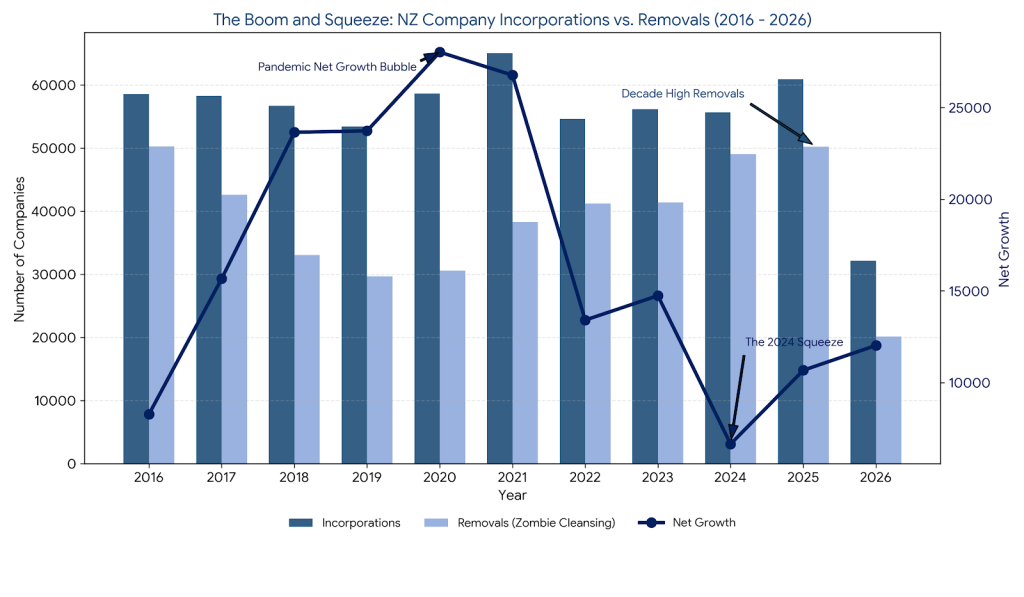
As pandemic-era support completely dried up and standard enforcement actions returned, the market experienced a severe tightening. This culminated in 2024, which saw a multi-year low in new incorporations and a surge in closures, resulting in the narrowest margin of net corporate growth (+6,645 companies) seen in a decade.
By 2025, company removals peaked at over 50,000, matching the historic high-stress levels last seen in 2016. This surge represents a massive, necessary clearing out of “zombie companies” that simply could not survive the modern pressures of sustained high interest rates, flat productivity, and intense margin compression.
While the first half of 2026 indicates early signs of the growth ratio stabilising, the volume of corporate distress remains highly elevated.
This graph below illustrates three distinct phases:
- The Net Growth Bubble (2019-2021): You can see the green net growth line peak sharply in 2020 as removals (red bars) artificially dropped due to pandemic stimulus.
- The Squeeze (2024): The green line plummets to its lowest point as the gap between incorporations and removals narrows drastically.
- The Catch-Up / Zombie Cleansing (2025): The red removal bars peak, matching the historic highs seen back in 2016, clearing out the unviable businesses that were kept afloat during the stimulus years.
The ethical obligation of advisors
For accountants, directors, and business advisors, these macro statistics translate directly into urgent boardroom conversations.
When a business enters a prolonged state of distress, there is a distinct ethical boundary that must be managed. Propping up a structurally unviable entity on the goodwill of unpaid creditors, delayed tax obligations, or stretched supplier terms is not a sustainable commercial strategy. In fact, delaying the inevitable only serves to magnify the eventual financial fallout for the wider business community.
Not all business failures need to be terminal, however. A business is separate from the limited liability company that defines its legal boundaries. It is an ecosystem of people, intellectual property, history, and customer relationships.
A pragmatic path to renewal
Where a business possesses a genuinely viable core but is weighed down by legacy, pre-pandemic debts, Parliament has provided specific legal frameworks to allow for a second chance.
Under sections 386 of the Companies Act 1993, a compliant Phoenix restructure offers a legal and ethical mechanism to rescue a viable business operation, saving jobs and preserving commercial relationships, rather than defaulting to a destructive liquidation.
The stimulus era is over, and the market is actively correcting itself. The most responsible path forward for advisors today is to confront the reality of the ledger early, separating the viable ideas from the unviable structures before the choice is taken out of their hands.
Waterstone regularly hosts professional development and CPD sessions outlining the legal, ethical, and practical mechanics of business restructuring. Contact our team to learn more about navigating corporate distress and restructuring options.

